
This article is part of our Complete Guide to Hiring Tech Talent in Brazil.
If you’re a US company scaling engineering headcount, you’ve probably weighed offshore hubs in Eastern Europe or South and Southeast Asia against nearshore options closer to home. Brazil has become one of the main nearshore destinations for US tech teams, and cost is only part of the reason.
What “Nearshore” Actually Means
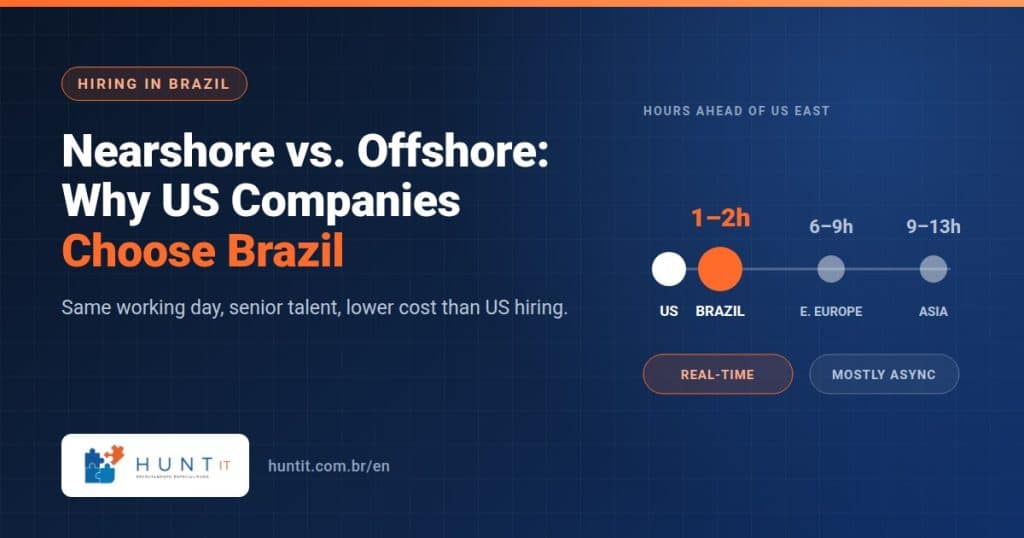
Nearshoring means hiring talent in a country close enough to your time zone for real-time collaboration: daily standups, live pair programming, same-day code review. Offshoring usually means a large time difference, often 9 to 13 hours, and a workflow that has to run mostly async.
Neither is wrong. But they suit different kinds of work. Well-specified, self-contained projects can run offshore. Product engineering, where your engineers work alongside product managers, designers and the rest of your team every day, works much better when everyone shares the working day.
The Time Zone Advantage
Brazil’s tech hubs (São Paulo, Porto Alegre, Rio de Janeiro, Florianópolis) run on Brasília Time (UTC-3), with no daylight saving. Relative to the US, that means:
| US time zone | Brazil is ahead by | Shared working day |
|---|---|---|
| Eastern | 1–2 hours | Almost the full day |
| Central | 2–3 hours | Most of the day |
| Mountain | 3–4 hours | Around half the day |
| Pacific | 4–5 hours | A solid morning block |
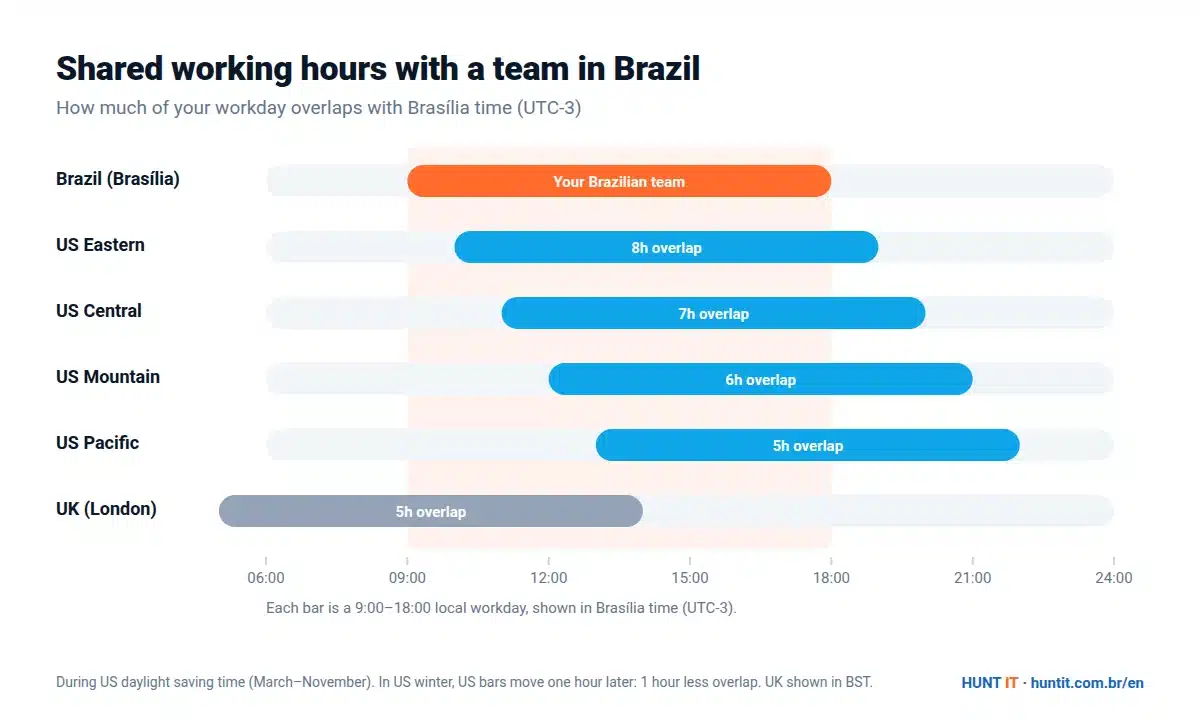
In practice: standups where nobody joins at 9pm, pull requests reviewed the same day instead of on a 24-hour round trip, and Brazilian engineers who can join client and stakeholder calls live. For the full breakdown, see Brazil’s timezone advantage.
Talent Depth and Seniority
Brazil has one of the largest developer communities in Latin America, with a mature university system and a tech industry that grew around large fintechs, banks, e-commerce and SaaS companies. That produced a deep bench of mid-level and senior engineers in backend, data, cloud and DevOps, many already used to agile teams, code review culture and international stacks.
The practical consequence for you: in Brazil you can hire for seniority, not just for volume.
Cost: Lower Than the US, Without Trading Down
A senior engineer in Brazil costs less than an equivalent hire in the US. The more useful comparison, though, is total cost of the work delivered. A cheaper hourly rate offshore can be eaten up by coordination overhead, slower feedback loops and rework caused by async misunderstandings. Nearshore narrows that gap because your team works together in real time.
Real cost depends on stack, seniority, English level and contract model. See what it costs to hire a Brazilian developer.
Nearshore vs. Offshore at a Glance
| Nearshore (Brazil) | Offshore (Asia, Eastern Europe) | |
|---|---|---|
| Time zone overlap with the US | Most or all of the working day | Little to none, depending on the hub |
| Collaboration style | Real-time | Mostly async |
| Best for | Product teams working alongside your own | Well-specified, self-contained projects |
| Cost vs. US | Lower | Often lower still, per hour |
| Travel | One overnight flight from many US cities | Long-haul, multiple time zones |
How Hiring Actually Works
Most US companies hire Brazilian engineers in one of two ways:
- Employer of Record (EOR): a provider legally employs the engineer on your behalf and handles payroll, taxes and compliance
- Direct contractor (PJ): the engineer invoices your company from their own Brazilian company, common for senior remote roles
We explain both, including the legal points to watch, in our PJ vs. CLT guide.
What to Watch Out For
- Treating it like a domestic hire. Brazilian labor law and contractor rules work differently from the US.
- Taking seniority at face value. Titles vary between companies. Make sure someone actually validates technical depth.
- Assuming English from the CV. Reading documentation and debating a design decision on a live call are different skills. Test the second one.
- Not setting the salary range in USD upfront. Candidates often reprice once the offer is in dollars.
If you’re choosing someone to help you hire, here’s how to choose a nearshore recruitment partner in Brazil.
Frequently Asked Questions
What time zone is Brazil in?
The main tech hubs use Brasília Time (UTC-3) year-round, with no daylight saving. That is 1–2 hours ahead of US Eastern and 4–5 hours ahead of Pacific, depending on US daylight saving.
Is Brazil cheaper than hiring in the US?
Yes, for equivalent seniority. The exact difference depends on the role, stack, English level and contract model.
Do Brazilian developers speak English?
Many senior engineers work in English every day, especially those at fintechs and product companies. Level varies a lot, so test live, spoken English before you hire. HUNT IT runs an English assessment with a language specialist for every candidate we send to an international role.
How long does it take to hire a Brazilian developer through HUNT IT?
First vetted profiles in 5 business days after the calibration call, and 95% of the profiles we send get an interview.
Ready to Build Your Nearshore Team in Brazil?
HUNT IT finds, technically vets and English-tests senior Brazilian engineers for international companies. You hire them directly, with a one-time success fee and a 90-day guarantee. See how our nearshore recruitment works.