
This article is part of our Complete Guide to Hiring Tech Talent in Brazil.
You’ve decided to build part of your engineering team in Brazil. The timezone works, the talent is there, and the numbers make sense. The next decision is who helps you hire, and it matters more than it looks.
Search for “hire developers in Brazil” and you’ll find three very different kinds of company using the same words: staffing firms that employ the engineer and bill you every month, Employer of Record platforms that handle payroll but don’t find anyone, and recruitment firms that find the engineer and step out. They solve different problems. Picking the wrong type costs you money every month. Picking a weak partner of the right type costs you three months and a bad hire.
Here are eight questions to ask before you sign.
First, Know Which Model You’re Buying
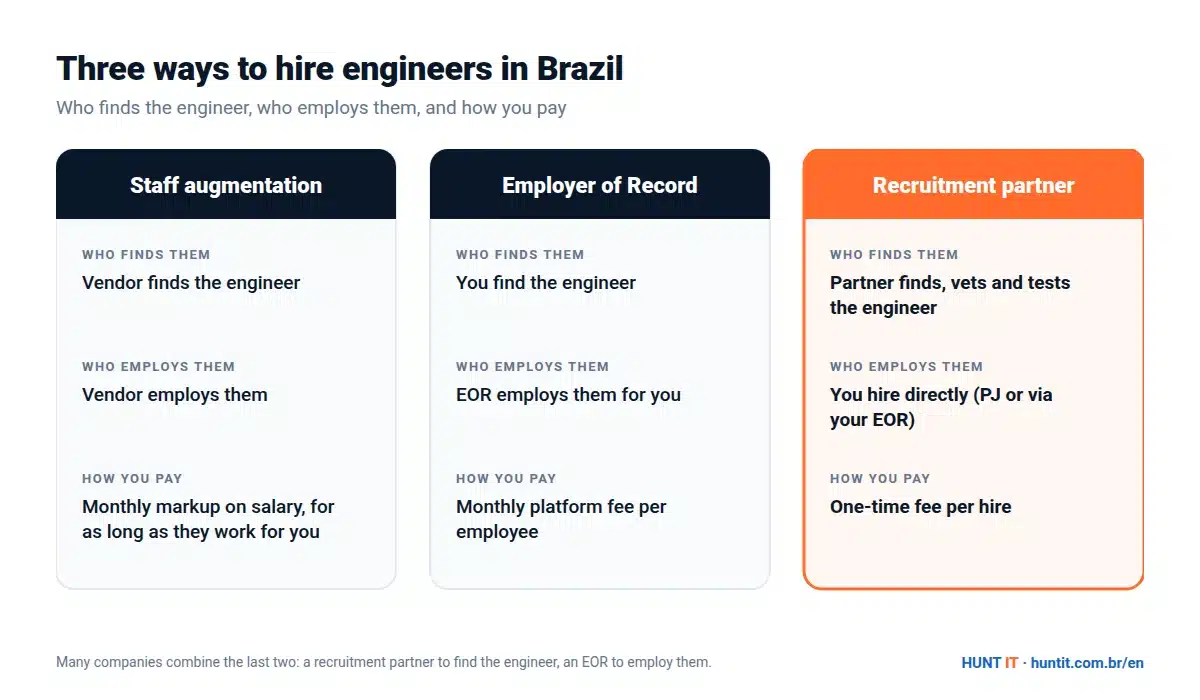
| Staff augmentation | Employer of Record (EOR) | Recruitment partner | |
|---|---|---|---|
| Finds the engineer | Yes | No | Yes |
| Employs the engineer | Yes | Yes | No, you do (directly or via an EOR) |
| How you pay | Monthly markup on the salary, for as long as the engineer works for you | Monthly platform fee per employee | One-time fee per hire |
| Who the engineer works for | The vendor | The EOR, on paper | You |
| Best when | You need people fast, short term, and don’t want to manage them directly | You already found the person and need compliant payroll | You want to build your own team and keep it |
None of these is wrong. But if you plan to keep an engineer for three years, a monthly markup adds up fast. And an EOR won’t find anyone for you. Many companies end up combining the two: a recruitment partner to find the engineer, and an EOR to employ them.
1. Do They Recruit Only for Technology?
A generalist agency can fill a sales role on Monday and a DevOps role on Tuesday, and the second one shows. Tech recruiting needs someone who knows that three years of Kubernetes in production is not the same as a certification, and who can tell a senior engineer from a well-presented mid-level one.
Ask: What share of your placements are engineering roles? Who does the technical screen, and what do they check?
2. How Do They Validate Seniority?
Titles in Brazil are as inconsistent as anywhere. “Senior” can mean eight years of architecture decisions or four years of maintaining one system. A good partner screens for what the candidate actually built, owned and decided, not what the job title says.
Ask: Can you show me an example of your written assessment of a candidate? If what they send back is only a CV with a summary on top, that’s your answer.
3. How Do They Test English?
This is where most nearshore hires fail. Plenty of Brazilian engineers read and write technical English well. Fewer can defend a design decision on a live call with a native speaker who talks fast. Both are called “fluent” on a CV.
Ask: Is English assessed by a specialist, or by the recruiter during the interview? What exactly is assessed: reading, writing, or live conversation? Do I see the result before I interview?
4. Do They Tell You What the Market Pays in USD?
Candidates often price themselves differently once the offer is in dollars. A partner who doesn’t set the salary range before the search starts will lose candidates at the offer stage, after your team has already invested hours in interviews.
Ask: Before we open the search, can you tell me the realistic range for this profile, in USD? What happens if my budget is below it?
A good partner will tell you on the first call if the role as written doesn’t exist at your budget.
5. How Do They Source?
The best senior engineers in Brazil are usually employed and not applying for jobs. A partner who only posts ads and filters applicants will show you who’s looking, not who’s best.
Ask: What share of your shortlists comes from active sourcing versus inbound applications? Do you have your own database of engineers?
6. How Is the Fee Structured, and What Does It Cover?
Know exactly what you’re paying for and for how long. A one-time success fee means you pay once, when you hire. A monthly markup means you keep paying for as long as the engineer works for you.
Ask: Is the fee one-time or recurring? Is there a retainer? What’s the replacement guarantee, and for how long?
7. Do They Understand How You’ll Contract the Engineer?
International companies usually hire Brazilian engineers either as direct contractors (PJ) or through an Employer of Record. Your recruitment partner doesn’t need to be a law firm. But they should understand both models well enough to set expectations with the candidate from the first conversation, including how the engineer will be paid and in which currency.
Ask: How do your candidates usually get hired by international clients? What do you tell the candidate about the contract model?
More detail: PJ vs. CLT: how hiring actually works in Brazil.
8. Will They Tell You When They’re Not the Right Fit?
Every partner has a sweet spot. A firm that says yes to junior volume hiring, C-level search and payroll all at once is probably good at none of them.
Ask: What kind of hire are you not the right partner for?
It’s the most useful question on this list. A partner who can answer it clearly knows what they’re good at.
Red Flags
- A shortlist in 24 hours for a senior role. Either there’s no vetting or it’s the same list everyone else got.
- No calibration call before the search starts.
- “All our candidates speak fluent English,” with no explanation of how that’s measured.
- A monthly fee on the salary presented as “recruitment”.
- Vague answers about who does the technical screen.
How HUNT IT Answers These Questions
HUNT IT is a Brazilian recruitment firm that has worked only with technology for more than 15 years, with offices in São Paulo and Porto Alegre.
- Only tech. Our recruiters specialize in engineering roles.
- Calibration first. Every search starts with a call with your tech lead and a realistic salary range in USD.
- English tested by a specialist. Every candidate for an international role goes through an English assessment focused on live, working conversation. You see the result before you interview.
- First vetted profiles in 5 business days. 95% of the profiles we send get an interview.
- One-time success fee. You pay when you hire. No retainer, no monthly markup. 90-day replacement guarantee.
- You hire directly. As a contractor (PJ) or through your EOR. The engineer works for you, not for us.
- What we don’t do: we’re not an EOR, we don’t run payroll, and we’re not the right partner for junior hiring in volume.
See how our nearshore recruitment works →
Frequently Asked Questions
What’s the difference between a nearshore recruitment partner and staff augmentation?
A recruitment partner finds the engineer, and you hire them directly or through your EOR, usually for a one-time fee. Staff augmentation firms employ the engineer themselves and charge you a monthly markup for as long as they work for you.
Do I need a recruitment partner if I already use an EOR?
Usually, yes. An EOR handles employment, payroll and compliance once you’ve chosen someone. It doesn’t source, vet or test candidates. The two work together.
How long does it take to hire a senior engineer in Brazil?
With a specialized partner, first vetted profiles typically arrive within a week. Total time to a signed contract depends on your interview process and the candidate’s notice period.
What should a replacement guarantee cover?
A new search at no extra fee if the hire leaves or doesn’t work out within the guarantee period. 90 days is a common standard.